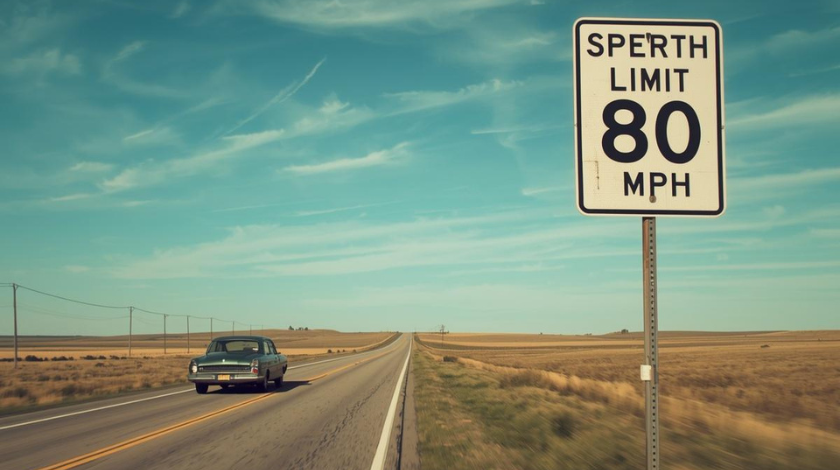
If you have driven across North Dakota on Interstate 94 or Interstate 29 recently, you might have noticed something different about the flow of traffic. People are moving faster, and legally so. As of August 1, 2025, North Dakota officially raised its interstate highway speed limit from 75 mph to 80 mph, joining a growing club of states that recognize the realities of modern highway driving while balancing safety concerns with the practical needs of travelers crossing the vast open spaces of the Great Plains.
I remember the first time I drove across North Dakota. It was the middle of summer, and I was heading west on I-94 toward Montana. The road stretched out before me like a ribbon across an ocean of grass and sky. For hours, I barely touched the brake pedal. The previous 75 mph limit felt almost artificially slow given the straight, flat terrain and minimal traffic. Like many drivers, I found myself naturally settling into a speed closer to 80 mph anyway, not because I was trying to break the law, but because that speed simply felt right for the conditions. Apparently, state lawmakers came to a similar conclusion after years of debate and study.
What Changed: Understanding House Bill 1298
The change did not happen overnight. In fact, this was not the first time legislators had tried to raise the speed limit. Back in 2023, then-Governor Doug Burgum vetoed a similar bill, citing safety concerns and wanting more data before making such a significant change. But the 2025 legislative session brought in new leadership and, apparently, new perspectives on the issue.
Governor Kelly Armstrong signed House Bill 1298 into law on May 5, 2025, making North Dakota the ninth state in the country to adopt an 80 mph maximum speed limit on certain highways. The law took effect on August 1, 2025, giving the North Dakota Department of Transportation time to prepare for the logistical challenge of updating hundreds of speed limit signs across the state.
In his signing statement, Governor Armstrong struck a measured tone, acknowledging that this change was about more than just letting people drive faster. “This bill strikes a reasonable balance by aligning North Dakota’s interstate speed limit with two of our three neighboring states and increasing fines as a deterrent to speeding,” he said. That last part is crucial and often overlooked in discussions about higher speed limits. Yes, you can now legally drive 80 mph on many stretches of North Dakota interstates, but if you push beyond that, the financial consequences have gotten steeper.
The bill represents a compromise between those who wanted the freedom to drive faster on wide-open highways and safety advocates who worry about the relationship between speed and serious accidents. By coupling the speed increase with higher fines and creating more 70 mph zones in populated areas, lawmakers attempted to thread the needle, satisfying both camps while acknowledging that most people were already driving around 80 mph anyway.
Where You Can Actually Drive 80 MPH (And Where You Cannot)
Here is where things get a bit complicated, and paying close attention to road signs becomes more important than ever. The 80 mph limit does not apply everywhere on North Dakota interstates. In fact, in some areas, the speed limit has actually gone down, reminding drivers to stay alert and aware of changing conditions.
On the rural stretches of I-29 and I-94, away from major cities and challenging terrain, you can now legally cruise at 80 mph. These are the long, straight sections where you can see for miles in every direction, where the only traffic might be a grain truck heading to the elevator or a family SUV packed for a road trip. According to David Finley, a spokesperson for the North Dakota Department of Transportation, the 80 mph limit applies to most of the state’s interstate mileage.
However, and this is a big however, several areas now have reduced speed limits compared to before. The speed limit has been lowered to 70 mph around Dickinson, Grand Forks, Jamestown, Medora, and Valley City. These areas previously had 75 mph limits but were reduced as part of the compromise to allow higher speeds elsewhere. Additionally, the slower speed zones around Bismarck and Fargo have been expanded. The 55 mph zone in West Fargo now stretches west to the Sheyenne Street exit, and the lower speed area east of Bismarck has been lengthened by one more exit to Exit 161.
Perhaps the most notable reduction is through the Badlands area on I-94 near Medora. Kirk Hoff, a design engineer at the North Dakota Department of Transportation, explained that this reduction was necessary due to road geometry. “We do have a few areas of concern where the horizontal curves don’t meet 80 miles an hour, particularly in the Badlands area,” he told KFYR-TV. “We’ll put it at 70 miles an hour through the Badlands.” This makes sense if you have ever driven that section of I-94. The road winds through stunning but challenging terrain, with curves that demand more attention than the straight prairie sections.
The message here is clear: higher speeds can increase accident risk, especially in transition zones near cities or challenging terrains like the Badlands. Drivers should stay alert and adjust their speed accordingly to ensure safety.
The Financial Reality: New Speeding Fines Explained
One aspect of this law change that has not received enough attention is the overhaul of North Dakota’s speeding fine structure. While you can now legally drive faster, the penalties for exceeding the limit have increased significantly. This was a deliberate trade-off designed to discourage the kind of excessive speeding that actually creates road danger.
Under the new system, fines are calculated more simply but can add up quickly. For highways with a speed limit of 65 mph or higher, which now includes most of the interstate system, the fine is $20 or $5 for each mile per hour over the limit, whichever is greater. If you exceed the limit by more than 16 mph, an additional $20 is tacked on. So if you get caught doing 95 in an 80 zone, you are looking at a $75 fine. But hit 96 mph, and that jumps to $100.
On other roads with lower speed limits, the fine is $20 or $3 per mph over, whichever is greater. Again, going 16+ mph over adds $20 to the total.
Construction zones have seen even steeper penalty increases. Speeding in a work zone with workers present now carries an additional $150 fine, up from the previous $80. Given that North Dakota has an active road construction season and plenty of highway maintenance projects, this is something every driver needs to take seriously. Those orange cones and reduced speed signs are not suggestions; they are warnings that your wallet will feel if you ignore them.
Interestingly, Lieutenant Jenna Clawson Huibregtse of the North Dakota Highway Patrol noted that the new fine structure actually makes their job easier. Previously, troopers had to consult about 10 different tables to calculate fines based on road type and speed. Now it is simplified to two main categories, plus special zones like construction and school areas. Despite the increases, she noted that North Dakota remains “the cheapest state in the nation to get a speeding ticket,” which might explain why some drivers feel comfortable pushing the limits.
The Sign Replacement Timeline: What to Expect
If you drove through North Dakota on August 1, 2025, you might have noticed something odd. The law changed that day, but many of the signs still showed 75 mph. That is because changing nearly 300 speed limit signs across the state takes time.
The North Dakota Department of Transportation contracted with 3D Specialties to handle the sign replacement, with work beginning on August 4, 2025. The process was expected to take about two weeks, with an estimated cost of $427,000. The work involves shoulder closures and traffic control, but should not significantly impact traffic flow.
Here is the important legal point: you could legally drive 80 mph starting August 1, even if the signs had not been changed yet. As Lieutenant Clawson Huibregtse explained, “It’s North Dakota law, so people are allowed to drive 80”. The signs are merely a notification of the law, not the law itself. Of course, this created a potentially confusing situation where drivers had to know the law independently of what the signs said, which is why the DOT worked to complete the changes as quickly as possible.
The sign replacement process also included installing new 70 mph signs in areas where the limit was reduced. So while drivers in rural areas saw the numbers go up, those approaching Dickinson, Grand Forks, Jamestown, Valley City, or Medora saw them go down. This dual change made the sign replacement project more complex than a simple swap of 75s for 80s.
Safety Considerations: What the Data and Experts Say
Any discussion of higher speed limits inevitably raises safety concerns, and rightfully so. Speed remains a significant factor in traffic fatalities nationwide, and North Dakota is no exception. According to state data, speed or aggressive driving was a factor in about one-third of the 96 fatal crashes in North Dakota in 2023, resulting in 1,427 injuries.
Catherine Chase, president of Advocates for Highway and Auto Safety, wrote to state lawmakers opposing the speed limit increase. Her argument was straightforward and backed by research: “Research and statistics consistently and convincingly show speeding is a major safety problem and raising speed limits increases traffic fatalities.” She noted that even seemingly modest speed limit changes can have significant impacts on overall traffic safety, particularly for vulnerable road users like motorcycle riders, construction workers, and first responders.
On the other side of the debate, State Representative Ben Koppelman, the Republican from West Fargo who introduced the legislation, argued that people drive based on what feels safe and comfortable, not strictly based on posted limits. He cited studies suggesting that when speed limits go up, drivers do not necessarily increase their speed by the same amount. The Highway Patrol backed this up with data showing the average speed on North Dakota interstates was already 81 mph before the law changed.
The Highway Patrol has emphasized that with higher speeds come greater responsibilities. Lieutenant Clawson Huibregtse specifically mentioned the need for increased following distances. At 80 mph, you are covering more than 117 feet per second. If the car in front of you brakes suddenly, you need significantly more distance to react and stop safely than you do at 65 or even 75 mph. This is not just theoretical; it is basic physics that could save your life.
My own experience driving at 80 mph on long road trips aligns with the Highway Patrol’s advice. When I set my cruise control to 80 on a recent trip across North Dakota, I made a conscious effort to increase my following distance and pay extra attention to what was happening several cars ahead, not just the vehicle immediately in front of me. The higher speed means everything happens faster, and you have less margin for error if something goes wrong.
How North Dakota Compares to Its Neighbors
One argument in favor of raising the speed limit was the need to align with neighboring states. South Dakota and Montana already had 80 mph limits on their interstate highways, while Minnesota remained at 70 mph on rural interstates. For anyone who regularly drives between these states, the inconsistency was noticeable and potentially confusing.
Now that North Dakota has joined the 80 mph club, the Dakotas and Montana are aligned, creating a more consistent driving experience across the northern Great Plains. This matters for commercial trucking, tourism, and regular commuters who cross state lines. It reduces the likelihood of drivers accidentally speeding because they forgot which state they were in or what the limit was.
Nationally, North Dakota became the ninth state with an 80 mph maximum speed limit, joining Idaho, Montana, Nevada, Oklahoma, South Dakota, Texas, Utah, and Wyoming. Texas remains the outlier with an 85 mph limit on certain sections of State Highway 130, the highest in the nation.
The regional comparison also highlights the different approaches states take to traffic safety. Minnesota, with its 70 mph limit, has taken a more conservative approach, though it is worth noting that Minnesota also has higher speeding fines than North Dakota. This creates an interesting dynamic for drivers in the Fargo-Moorhead area, where crossing the state line means adjusting both your speed and your awareness of enforcement practices.
Practical Tips for Driving at 80 MPH
If you are planning a trip through North Dakota or live in the state and want to take advantage of the new speed limit while staying safe and ticket-free, here are some practical tips based on my experience and the advice of traffic safety experts.
First, check your tires before any long trip at higher speeds. Tires rated for sustained highway speeds are essential, and underinflated tires become significantly more dangerous at higher speeds. The heat buildup at 80 mph is considerably greater than at 65 or 70, and a tire failure at high speed can be catastrophic.
Second, use your cruise control, but stay engaged. Cruise control helps maintain a steady speed and can improve fuel economy, but it should never be a substitute for active driving. Keep your eyes moving, scan the road ahead for brake lights or potential hazards, and be ready to take control immediately if conditions change.
Third, adjust for weather and road conditions. The 80 mph limit applies to ideal conditions: dry pavement, good visibility, and light traffic. When it rains, when fog rolls in, or when the road is under construction, you need to slow down regardless of what the sign says. North Dakota weather can change quickly, and a road that was perfect for 80 mph in the morning might require 60 mph or less by afternoon.
Fourth, watch your fuel economy. Most vehicles achieve their best fuel economy between 55 and 65 mph. At 80 mph, aerodynamic drag increases significantly, and your gas mileage will suffer. On a long trip across North Dakota, the time you save by driving faster might be offset by the extra stops for fuel. Do the math before you decide that 80 mph is always the best choice.
Finally, respect the reduced speed zones. The areas around cities and the Badlands section have lower limits for good reasons: more traffic, more curves, more potential for something unexpected to happen. Slowing down for these sections is not just about avoiding tickets; it is about recognizing that different driving environments require different approaches.
Conclusion
North Dakota’s move to an 80 mph interstate speed limit represents a significant change for drivers in the state, but one that reflects the reality of how people were already driving on the wide-open highways of the Great Plains. By aligning with neighboring South Dakota and Montana, the state has created more consistent traffic laws for regional travel while balancing the desire for faster travel with legitimate safety concerns.
The key to navigating this new speed limit successfully is understanding where it applies and where it does not, respecting the increased fines for violations, and adjusting your driving habits to account for the higher speeds. The 80 mph limit is not a license to stop paying attention; if anything, it requires more vigilance, longer following distances, and greater awareness of changing road conditions.
For me, the change means I can set my cruise control to the speed I was already driving without worrying about getting pulled over. But it also means I need to be more deliberate about my driving, more conscious of the increased risks, and more respectful of the reduced limits in urban areas and challenging terrain. The open road is faster now, but it demands the same respect it always has.
Frequently Asked Questions
When did North Dakota change the speed limit to 80 mph? The new 80 mph speed limit took effect on August 1, 2025, after Governor Kelly Armstrong signed House Bill 1298 into law on May 5, 2025.
Does the 80 mph limit apply to all highways in North Dakota? No. The 80 mph limit only applies to rural sections of I-29 and I-94. Urban areas and certain cities have reduced limits of 70 mph or lower.
Which cities have reduced speed limits on the interstate? The speed limit is reduced to 70 mph around Dickinson, Grand Forks, Jamestown, Valley City, and Medora. Additionally, the slower zones around Bismarck and Fargo have been expanded.
How much is a speeding ticket in North Dakota now? For highways with speed limits of 65 mph or higher, the fine is $20 or $5 per mph over the limit, whichever is greater. Going more than 16 mph over the limit adds $20. Construction zone fines have increased by an extra $150.
Can I drive 80 mph before the signs are changed? Yes. The law changed on August 1, 2025, regardless of what the signs say. However, drivers should be aware of where the 80 mph limit actually applies versus where it remains lower.
How does North Dakota compare to other states? North Dakota is the ninth state with an 80 mph limit, joining South Dakota, Montana, Idaho, Nevada, Utah, Wyoming, Oklahoma, and Texas (which has 85 mph on some roads).
Is it safe to drive 80 mph? Safety depends on road conditions, weather, traffic, and driver attention. The Highway Patrol recommends increasing following distances at higher speeds and adjusting speed for conditions.
Read Also: 605 Area Code